

Let's kickstart the project TODAY!

PCB Fabrication & Assembly
You made it here. Congratulations. Your design is ready to leave the screen and set off to become a great invention.
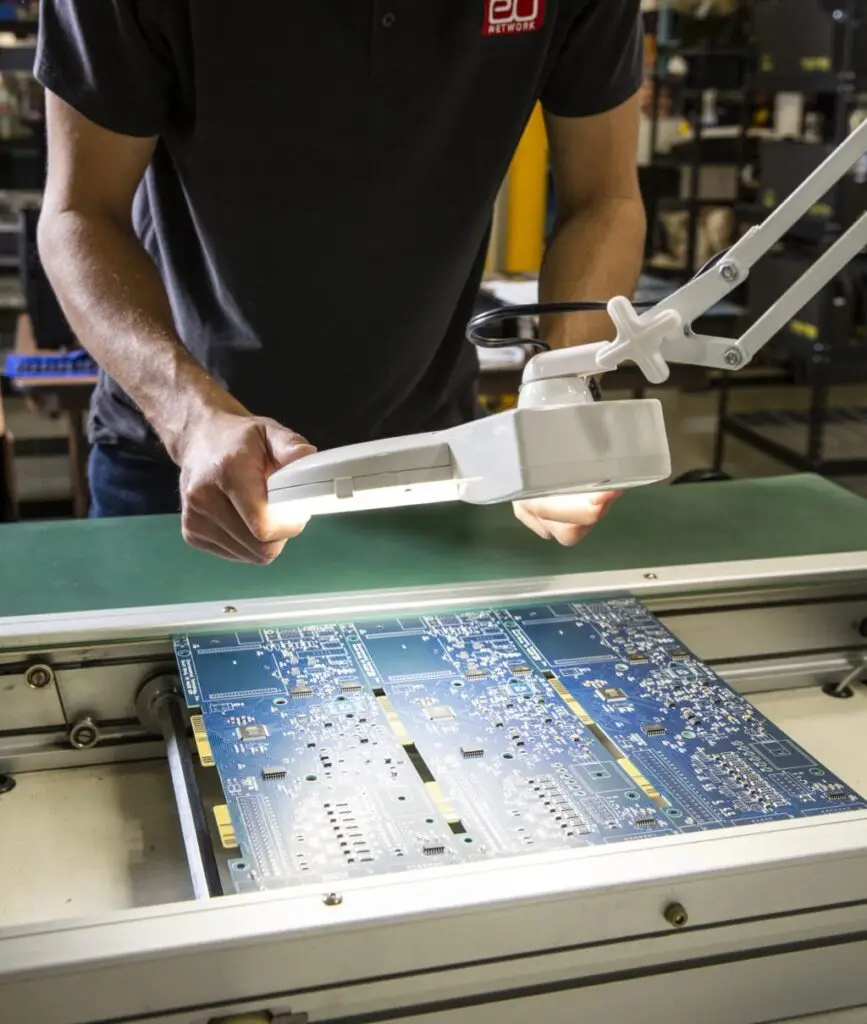
ETI Controls coordinates fabrication, assembly, and inspection as one program, so decisions, materials, and changes stay aligned from the first panel to the last board. We provide surface-mount and through-hole assembly. Soldering defines reliability, so we pair automated soldering for consistent joints with expert hand soldering for delicate or high-mass parts to prevent bridging, open circuits, voids, and heat damage. Before any build is released, every board passes automated optical inspection, and our quality team reviews workmanship, polarity, labeling, and cleanliness.
The wrong production choice creates rework, missed windows, and costs that hide in scrap and support. The right partner delivers quality, reliability, and durability when details get difficult. Send your Gerbers, BOM, and CPL. We will prepare a controlled plan, build your boards, and return evidence you can trust.

Full Turnkey and Partial Turnkey
Full turnkey means one partner owns the outcome. We manage fabrication, component sourcing, assembly, and inspection under a single engineering plan, with clear checkpoints and a single point of contact. This tight control reduces handoffs, protects low-volume budgets, and keeps quality decisions consistent across the entire build.
Partial turnkey is available when you prefer to supply bare boards, components, or specific steps. It can raise total cost at small volumes, blur responsibility if issues appear, and introduce delays when multiple suppliers move at different speeds. Choose it when internal constraints require it, not because it sounds simpler on paper.
If you provide parts or boards, help us protect quality from the start. Share a BOM with manufacturer part numbers and approved alternates, include reasonable overage in ESD-safe packaging, and label quantities and lot codes. Provide a complete CPL with designators, X and Y coordinates, rotation, and side. Panel rails, fiducials, and a clear test plan shorten diagnostics and keep the building on track.
If your priority is time well spent and consistent results, full turnkey lets you focus on the product while we carry the manufacturing load. Either way, we will document decisions, measure what matters, and deliver boards that perform where it counts.
Full Turnkey vs. Partial Turnkey | Full Turnkey | Partial Turnkey |
|---|---|---|
| One partner manages fabrication, sourcing, assembly, and inspection | ✅ | ⛔ |
| Single engineering plan with clear checkpoints and ownership | ✅ | ⛔ |
| Single point of contact for issues and changes | ✅ | ⛔ |
| Fewer handoffs, fewer delays, smoother flow | ✅ | ⛔ |
| You supply bare boards, components, or specific steps | ⛔ | ✅ |
| Higher risk of delays when multiple suppliers move at different speeds | ⛔ | ✅ |
| Responsibility can blur if field issues appear | ⛔ | ✅ |
| Extra coordination on your side between vendors | ⛔ | ✅ |
| Need to provide parts with overage, ESD-safe packaging, labels, lot codes, and full CPL, etc. | ⛔ | ✅ |
| You focus on product and roadmap while partner carries the manufacturing load | ✅ | ⛔ |
PCB Specifications
PCB Specifications
| PCB Specifications | ||
|---|---|---|
| Features | Capability | Description |
| Layer count | 1-32 Layers | The number of copper layers in the PCB |
| Controlled Impedance | 4/6/8/10/12/14/16/18/20/…/32 layers | User Guide to the JLCPCB Impedance Calculator JLCPCB Impedance Calculator |
| Impedance Tolerance | ±10% | |
| Material | FR-4 | Grade A laminates from suppliers including Nan Ya, KB, Shengyi and etc. |
| Aluminum-Core | 1-layer Aluminum-core PCBs | |
| Copper-Core | 1-layer copper-core PCBs with direct heatsink contacts to core (≥ 1 × 1 mm) | |
| RF PCB | 1 oz copper, 2-layer RF PCBs with Rogers and PTFE cores | |
| FR-4 Dielectric Constants |
4.5 (2-Layer PCB) 7628 Prepreg 4.4 3313 Perpreg 4.1 2116 Perpreg 4.16 |
|
| Maximum Dimensions |
FR4 PCB: 670 × 600 mm Rogers / PTFE Teflon PCB: 590 × 438 mm Aluminum PCB: 602 × 506 mm Copper PCB: 480 × 286 mm |
These limits apply to PCBs with thickness ≥ 0.8 mm. The thinner FR4 PCBs are 500 × 600 mm maximum. 2-layer FR4 PCBs can reach a maximum size of 1020 × 600 mm. |
| Minimum Dimensions | Regular: 3 × 3 mm. Castellated / Plated Edges: 10 × 10 mm. | These limits apply to PCBs with thickness ≥ 0.6 mm. Manual review required for thinner PCBs. Panelization is recommended for small-sized boards. |
| Dimension Tolerance | ±0.1mm | ±0.1mm(Precision) and ±0.2mm(Regular) for CNC routing, and ±0.4mm for V-scoring |
| Thickness | 0.4 – 4.5 mm | Thickness for FR4 are: 0.4/0.6/0.8/1.0/1.2/1.6/2.0 mm (2.5 mm and above are for 12+ layer PCBs only) |
| Thickness Tolerance (Thickness≥1.0mm) | ± 10% | e.g. For the 1.6mm board thickness, the finished board thickness ranges from 1.44mm(T-1.6×10%) to 1.76mm(T+1.6×10%) |
| Thickness Tolerance (Thickness<1.0mm) | ± 0.1mm | e.g. For the 0.8mm board thickness, the finished board thickness ranges from 0.7mm(T-0.1) to 0.9mm(T+0.1). |
| Finished Outer Layer Copper |
2-layer: 1 oz / 2 oz / 2.5 oz / 3.5 oz / 4.5oz Multi-layer: 1 oz / 2 oz |
|
| Finished Inner Layer Copper | 0.5 oz / 1 oz / 2 oz | Finished copper weight of inner layer is 0.5oz by default. |
| Soldermask | Green, Purple, Red, Yellow, Blue, White, and Black. | We use LPI (Liquid Photo Imageable) solder mask. This is the most common type of mask used today. Heat-cured ink soldermask is usually found on low-cost, single-sided PCBs. |
| Surface Finish | HASL (leaded / lead-free), ENIG, OSP (copper core boards only) |
FR4 has all three finishes available, 6+ layers and RF boards only have ENIG. Aluminium core boards only have HASL. Copper core boards only have OSP. |
Drilling
| Drilling | ||
|---|---|---|
| Features | Capability | Description |
| Drill Diameter |
1-layer: 0.3 – 6.3 mm 2-layer: 0.15 – 6.3 mm Multilayer: 0.15 – 6.3 mm |
Holes with diameter ≥ 6.3 mm are CNC routed from a smaller drilled hole. Min. drill diameter for 2- or more-layer PCBs is 0.15 mm (more costly!). Min. drill diameter for aluminum-core PCBs is 0.65 mm. Min. drill diameter for copper-core PCBs is 1.0 mm. |
| Hole size Tolerance (Plated) |
Through-holes: +0.13 / -0.08 mm Press-fit holes: ±0.05 mm (multilayer ENIG boards only) |
e.g. for the 0.6mm hole size, the finished hole size between 0.52mm to 0.73mm is acceptable. |
| Hole size Tolerance (Non-Plated) | ±0.2mm | e.g. for the 1.00mm Non-Plated hole, the finished hole size between 0.80mm to 1.20mm is acceptable. |
| Average Hole Plating Thickness | 18μm | |
| Blind/Buried Vias | Not supported | Currently we don’t support Blind/Buried Vias, only make through holes. |
| Min. Via hole size/diameter | 0.15mm / 0.25mm |
1-layer (NPTH only): 0.3 mm hole size / 0.5 mm via diameter 2-layer: 0.15mm hole size / 0.25mm via diameter Multilayer: 0.15 mm hole size / 0.25 mm via diameter ① Via diameter should be 0.1mm (0.15mm preferred) larger than via hole size. ② Preferred Min. Via hole size: 0.2mm. |
| Min. Non-plated holes | 0.50mm | Please draw NPTHs in the mechanical layer or keep out layer. |
| Min. Plated Slots | 0.5mm |
The minimum plated slot width is 0.5mm, which is drawn with a pad. The length of the slot should be at least 2 times of the width. |
| Min. Non-Plated Slots | 1.0mm | The minimum Non-Plated Slot Width is 1.0mm, please draw the slot outline in the mechanical layer (GM1 or GKO). |
| Via Hole-to-Hole Spacing | 0.2mm | |
| Pad Hole-to-Hole Spacing | 0.45mm | |
| Min. Castellated Holes | 0.5mm |
Castellated holes are metalized half-holes on PCB edges, commonly used on daughter boards to be soldered onto carrier PCBs. ① Hole diameter (Φ): ≥ 0.5 mm ② Hole to board edge (L): ≥ 1 mm ③ Hole to hole (D): ≥ 0.5 mm ④ Min. PCB size: 10 × 10 mm ⑤ Min. PCB thickness: 0.6 mm |
| Plated Edges | 10 × 10mm |
Plated edges are copper-plated and ENIG treated. HASL is not supported. ① Min. PCB size: 10 × 10 mm ② Min. PCB thickness: 0.6 mm ③ At least 3 breaks (more for larger PCBs) in the edge plating are required for support tab connections. |
| Blind Slot | W ≥ 1.0mm, D ≥ 0.2mm |
① Blind slot width (W): ≥1.0mm ② Blind slot depth (D): ≥0.2mm ③ Blind slot annular width (A): ≥0.3mm (pad width of PTH blind slots) ④ Safety distance (S): ≥0.2mm (distance from NPTH blind slots to pad/traces/copper plane) ⑤ Blind slot remaining thickness (R): ≥0.2mm (distance from bottom of blind slot to nearest inner copper layer / surface substrate) ⑥ Supports 2–32-layer FR4 boards with thickness ≥0.8mm |
| Rectangular Holes / Slots | Not supported | Rectangular holes and slots without rounded corners are not supported. |
Traces
| Traces | ||
|---|---|---|
| Features | Capability | Description |
| Min. track width and spacing (1 oz) | 0.10 / 0.10 mm (4 / 4 mil) |
1- and 2-layer: 0.10 / 0.10 mm (4 / 4 mil). Multilayer: 0.09 / 0.09 mm (3.5 / 3.5 mil). 3 mil is acceptable in BGA fan-outs. |
| Min. track width and spacing (2 oz) | 0.16 / 0.16 mm (6.5 / 6.5 mil) |
2-layer: 0.16 / 0.16 mm (6.5 / 6.5 mil). Multilayer: 0.16 / 0.20 mm (6.5 / 8 mil). |
| Min. track width and spacing (2.5 oz) | 2-layer: 0.2 / 0.2 mm (8 mil / 8 mil) | |
| Min. track width and spacing (3.5 oz) | 2-layer: 0.25 / 0.25 mm (10 mil / 10 mil) | |
| Min. track width and spacing (4.5 oz) | 2-layer: 0.3 / 0.3 mm (12 mil / 12 mil) | |
| Track width tolerance | ±20% | e.g. For a 0.1 mm track, the finished track width ranges from 0.08 and 0.12 mm. |
| PTH annular ring | ≥ 0.20 mm |
2-layer: • 1 oz: Recommended 0.25 mm or above; absolute minimum 0.18 mm. • 2 oz: 0.254 mm or above. Multilayer: • 1 oz: Recommended 0.20 mm or above; absolute minimum 0.15 mm. • 2 oz: 0.254 mm or above. |
| NPTH pad annular ring | ≥ 0.45 mm | Recommended 0.45 mm or more. This is to allow a 0.2 mm ring of copper to be removed around the hole for the sealing film to attach. Pad sizes smaller than the recommended value can result in the annular ring being very thin or completely missing. |
| BGA | 0.25 mm |
① BGA pad diameter ≥ 0.25 mm. ② BGA pad to trace clearance ≥ 0.1 mm (min. 0.09 mm for multilayer boards). ③ Vias can be placed within BGA pads using filled and plated-over vias. More BGA layout guidance is available in JLCPCB’s BGA design guidelines. |
| Trace coils | 0.15 / 0.15 mm |
Minimum trace width/clearance: 0.15 / 0.15 mm when traces are covered by solder mask (1 oz). Minimum trace width/clearance: 0.25 / 0.25 mm when traces are NOT covered by solder mask (1 oz). ENIG only (high risk of short circuit with HASL). |
| Hatched grid width and spacing | 0.25 mm | |
| Same-net track spacing | 0.25 mm | |
| Inner layer via hole to copper clearance | 0.2 mm | |
| Inner layer PTH pad hole to copper clearance | 0.3 mm | |
| Pad to track clearance | 0.1 mm | Min. 0.1 mm (stay well above if possible). Min. 0.09 mm locally for BGA pads. |
| SMD pad to pad clearance (different nets) | 0.15 mm | More details of SMD pad spacing: SMD Components Minimum Spacing. |
| Via hole to Track | 0.2 mm | |
| PTH to Track | 0.28 mm | 0.35 mm is recommended, minimum 0.28 mm. |
| NPTH to Track | 0.2 mm | |
Soldermask
| Soldermask | ||
|---|---|---|
| Features | Capability | Description |
| Soldermask Expansion | 1:1 |
LDI equipment upgraded in June 2025. Pad size : soldermask opening can be 1:1 (previous production file will be followed in reorder). Keep at least 0.09 mm clearance between soldermask openings and neighboring traces. |
| Soldermask bridge | 0.10mm |
1 oz: • Min. pad spacing: 0.10 mm (green, red, yellow, blue, purple) • Min. pad spacing: 0.13 mm (black, white) 2 oz: • Min. pad spacing: 0.20 mm (any color) |
| Plugged vias | Filled with soldermask |
Vias are filled with soldermask for an opaque finish. ① Filled vias must not have soldermask openings on either side. ② Filled vias should have ≥ 0.35 mm clearance from other soldermask openings (e.g. pads). ③ Filled vias must be no wider than 0.5 mm diameter. |
| JLCPCB Via-in-Pad Process |
Epoxy Filled & Capped Copper paste Filled & Capped |
Vias are filled with epoxy resin or copper paste and then plated over to achieve an opaque and smooth finish. ① Vias are filled and plated over. Choose copper paste filling for applications requiring high thermal conductivity. ② This process is the default for 6-layer and above multilayer boards. ③ Compatible with via diameters from 0.15 to 0.5 mm. |
| Solder mask dielectric constant | 3.8 | |
| Solder mask ink thickness | ≥ 10μm | |
Legend
| Legend | ||
|---|---|---|
| Features | Capability | Description |
| Minimum Line Width | 6 mil (0.153mm) | Characters width less than 6 mil (0.153mm) will be unidentifiable. |
| Minimum text height | 40 mil (1.0mm) | Characters height less than 40 mil (1.0mm) will be unidentifiable. |
| Character width to height ratio | 1:6 | The preferred ratio of width to height is 1:6. |
| Hollow-carved Character width to height ratio | 1:6 | The preferred ratio of width to height is 1:6. |
| Pad To Silkscreen | 0.15mm | The minimum distance between pad and silkscreen is 0.15mm. |
Outline
| Outline | ||
|---|---|---|
| Features | Capability | Description |
| Routed | 0.2mm |
① Copper clearance from routed board edges: ≥ 0.2 mm ② Copper clearance from routed slots: ≥ 0.2 mm ③ Dimension tolerance for routed board edges: ±0.2 mm (regular precision); ±0.1 mm (high precision) ④ Minimum dimension 50 × 50 mm for high precision, and at least 3 tooling holes with minimum 1.5 mm diameter on different corners. ⑤ Minimum slot width for aluminum/copper core PCB: 1.6 mm. |
| V-Cut | 0.4mm |
① Copper clearance from V-cut board edges: ≥ 0.4 mm ② Dimension tolerance for V-cut board edges: ±0.4 mm. PCB thickness ≥ 0.6 mm ③ Zero panel board spacing by default. Alternatively, V-cut along one direction with no spacing and route along the other direction with 1.6 or 2 mm board spacing. ④ Min. panel dimensions: 70 × 70 mm; max. panel dimensions: 475 × 475 mm ⑤ V-cut groove angle: 25° |
| Mouse bites Panel | 0.2mm |
① Copper clearance from non-mouse-bite board edges: ≥ 0.2 mm ② Dimension tolerance for non-mouse-bite board edges: ±0.2 mm (regular precision); ±0.1 mm (high precision) ③ Panel board spacing: 1.6 or 2 mm ④ Serrated edges will remain after depanelization ⑤ Minimum tooling edge width: 3 mm. For SMT assembly at JLCPCB, use 5 mm tooling edges, 2 mm tooling holes, and 1 mm fiducials centered at 3.85 mm from the panel edges. ⑥ Recommended diameter of mouse bite is 0.5–0.8 mm. Recommended distance between the two mouse-bites is 0.2–0.3 mm. The minimum width of breakaway tab is 4 mm. For breakaway with mouse-bites, the minimum width is 5 mm. |
| Panelization with space | 2mm | The spacing between boards should be ≥ 2 mm, as narrow spacing results in difficulties for routing and V-cut. |
| Panel of Circular PCBs | ≥ 20mm × 20mm | The single round board size should be ≥ 20 mm × 20 mm when choosing panel by JLCPCB. Panelize with stamp holes and add tooling strips on four board edges. |
| Flexible PCB Capabilities | |||
|---|---|---|---|
| Category | Features | Capability | Description |
| Layer Count | 1-layer, 2-layers, 4-layers | The number of copper layers in the FPC | Rigid-flex PCBs are not yet supported. |
| FPC Stack-Up | 1-Layer (25µm dielectric thickness) | FPC with copper and coverlay on the same one side only. Inner PI thickness: 25 µm | |
| 2-Layer (25µm dielectric thickness) | FPC with copper on both sides. Inner PI thickness: 25 µm | ||
| 1-Layer (50µm dielectric thickness) | Tear-resistant. | ||
| 2-Layer (50µm dielectric thickness) | Tear-resistant. Suitable for impedance-controlled boards. | ||
| 1-Layer (Transparent) | PET Thickness: 36 µm | ||
| 2-Layer (Transparent) | PET Thickness: 36 µm | ||
| 4-Layer |
Inner/outer layer copper weight: 1/3 oz, 0.5 oz, and 1 oz. Lamination structures: with coverlay or without coverlay. For inner layers with 1 oz copper weight, coverlay is applied by default to prevent delamination and blistering during lamination. |
||
| Dimensions | Maximum Dimensions | Regular: 234 × 490 mm | Absolute limit of 250 × 500 mm allowed with mandatory handling edges – confirm with customer support before ordering. |
| Minimum Dimensions | No limit | FPCs whose dimension is smaller than 20 × 20 mm are best panelised. See Flex PCB panel design guidelines. | |
| FPC Finished Thickness |
25µm dielectric thickness FPC: • 1-Layer: 0.07 / 0.11 mm • 2-Layer: 0.11 / 0.12 / 0.2 mm 50µm dielectric thickness FPC: • 1-Layer: 0.12 mm • 2-Layer: 0.19 mm Transparent FPC: • 1-Layer: 0.14 mm • 2-Layer: 0.24 mm |
The thickness of the finished FPC excluding any stiffeners. If the measured area has no copper or coverlay, the finished thickness will be reduced. | |
| Outer Layer Copper Weight |
Single-sided: 18 µm (0.5 oz), 35 µm (1 oz) Double-sided: 12 µm (0.33 oz), 18 µm (0.5 oz), 35 µm (1 oz) |
The thickness of copper on the FPC. | |
| Type of Process | Dry film process with LDI (laser direct image) exposure technology | LDI provides higher accuracy than traditional LED exposure. The machines also support automatic alignment based on board size to eliminate pad offset issues. | |
| Surface Finish | ENIG. Thickness: 1u" / 2u" | ENIG deposits a nickel-gold coating on exposed pads to prevent oxidation. | |
| Thickness with Stiffener | Thickness with Stiffener = FPC Thickness + Stiffener Thickness | Additional tolerance exists for stiffeners. Thicker stiffeners have larger tolerances. | |
| FPC Thickness Tolerance | ±0.05 mm | Additional tolerance exists for stiffeners; thicker stiffeners have larger tolerances. | |
| Holes | Hole Diameter | 0.15 – 6.5 mm | The recommended maximum diameter for PTHs is 5 mm; larger diameters may cause risks to production. |
| Diameter Tolerance | ±0.08 mm | Example: A 1.00 mm designed diameter is allowed to yield any physical diameter between 0.92–1.08 mm. | |
| Minimum Plated Slot | 0.50 mm | ||
| Minimum Non-Plated Slot | Not limited | At least 0.2 mm copper clearance is required around non-plated slots. | |
| Castellated Holes |
Castellated holes are plated half-holes on the edge of an FPC, most often used for press-soldered connectors. ① Castellated hole diameter: ≥ 0.3 mm ② Castellated hole to board edge: ≥ 0.5 mm ③ Castellated hole to hole: ≥ 0.4 mm |
||
| Min. Via hole size/diameter |
① Regular: 0.15 mm / 0.35 mm ② Extreme: 0.10 mm / 0.3 mm ③ Recommended: 0.3 mm / 0.55 mm |
Via diameter must be at least 0.2 mm larger than via hole size; 0.25 mm or above is better. | |
| Traces | Annular Ring for PTH | ≥ 0.25 mm recommended, absolute limit: 0.18 mm | |
| Minimum Trace Width/Spacing (1 oz) |
① 12 µm (0.33 oz) copper: 3/3 mil (absolute limit 2/2 mil – avoid if possible) ② 18 µm (0.5 oz) copper: 3.5/3.5 mil ③ 35 µm (1 oz) copper: 4/4 mil |
These are regular capabilities. Contact customer support for custom capability requirements. | |
| Trace Width Tolerance | ±20% | Example: A 0.10 mm designed trace width is allowed to yield any physical width between 0.08–0.12 mm. | |
| Pad-to-Trace Clearance |
① Via ring to trace: ≥ 0.1 mm (more whenever possible) ② Exposed pad to trace: ≥ 0.15 mm (more whenever possible) |
||
| NPTH to Copper Clearance | ≥ 0.20 mm | The clearance from an NPTH to traces, pads, and copper pours. | |
| BGA |
① BGA pad diameter: ≥ 0.25 mm ② BGA pad to trace clearance: ≥ 0.2 mm |
||
| Coverlay / Soldermask | Coverlay Color | Yellow / Black / White | Yellow is recommended. |
| Coverlay Opening |
Coverlay expansion (one-sided): 0.1 mm Coverlay opening to trace clearance: ≥ 0.15 mm (more whenever possible) |
||
| Via covering | Recommended to keep coverlay over vias. | ||
| Coverlay Thickness |
25µm dielectric thickness FPC: ① PI: 12.5 µm, Adhesive: 15 µm (on 1/3 oz or 0.5 oz copper) ② PI: 25 µm, Adhesive: 25 µm (on 1 oz copper) 50µm dielectric thickness FPC: • PI: 50 µm, Adhesive: 50 µm Transparent FPC: • PET: 25 µm, Adhesive: 25 µm |
Note: white coverlay is usually 13–18 µm thicker per side than yellow or black coverlay. | |
| Minimum solder bridge width | 0.5 mm minimum | Solder bridge narrower than 0.5 mm will be removed. Contact customer support for any non-standard requirements. | |
| Silkscreen | Character Height | ≥ 1 mm | More in case of complex patterns or knock-out text. |
| Character Line Width | ≥ 0.15 mm | Narrower lines do not print well. | |
| Character to Pad Clearance | ≥ 0.15 mm | Any silkscreen closer to a pad than this will be clipped. | |
| FPC Outline | Laser Outline |
① Copper to board edge ≥ 0.3 mm ② Copper to slots ≥ 0.3 mm ③ Outline tolerance: ±0.1 mm (±0.05 mm upon request) |
|
| Gold Finger Pad to Board Edge Clearance | 0.2 mm | Gold fingers will be cut back if exceeding this clearance to avoid damage during laser cutting the outline. Castellated pads are exempt from this clearance. | |
| Panels (See FPC Panel Design Guide) |
① Spacing between boards is commonly 2 mm. For boards with metal stiffeners use 3 mm instead. ② Handling edges of width 5 mm required on all four sides. Copper pour is required on these edges, with 1 mm clearance around fiducials and 0.5 mm clearance around tooling holes. ③ Fiducials: 1 mm; tooling holes: 2 mm; Fiducial centre to board edge: 3.85 mm. Add four fiducials with one offset by 5 mm or more to aid orientation. ④ Support tab width: 0.7–1.0 mm ⑤ Maximum panel size: 234 × 490 mm |
||
| Stiffeners (Detailed Introduction) | PI Stiffener | Thickness options: 0.1 mm, 0.15 mm, 0.20 mm, 0.225 mm, 0.25 mm | PI stiffeners are most often used with gold finger connectors. For example, if the connector needs to be 0.3 mm thick on a 0.11 mm FPC, a 0.225 mm stiffener thickness is most suitable. |
| FR4 Stiffener | Thickness options: 0.1 mm, 0.2 mm | FR4 is usually only used on low-end products because it is prone to chipping. Avoid if possible. | |
| Stainless Steel Stiffener | Thickness options: 0.1 mm, 0.2 mm, 0.3 mm | Steel stiffeners cost more but have excellent flatness and do not easily deform. This makes them good as support under SMD components. Note that since steel is slightly magnetic it should not be used with hall effect sensors or similar components. | |
| 3M Tape |
3M9077 (0.05 mm thick; heat-resistant) 3M468 (0.13 mm thick; not heat-resistant) |
Usually used to secure FPCs after assembly. | |
| EM Shielding Film | 18 µm thick, black | Helps lower EMC. The recommended practice is to add soldermask openings over edge guard rails to electrically connect them to the shield films. | |
| Design Considerations | Impedance Calculation |
Core polyimide εr: 3.3 Coverlay εr: 2.9 Core polyimide thickness: 25 µm |
Impedance measurement and control are not yet supported. Traces are only controlled for width and the customer is responsible for choosing trace widths to achieve their impedance requirements. |
| EasyEDA (Highly Recommended) | EasyEDA supports a dedicated stiffener layer. The shape and thickness of stiffeners are set and embedded in the design document so they don’t need to be entered manually when ordering. See how to design FPC at EasyEDA. | ||
| Other EDA Software | Put annotations on their own layer. Include the outlines of the stiffeners and indicate material and thickness. This information is not automatically parsed so stiffener options need to be set manually when ordering. Make sure that annotation text does not overlap the board area. | ||
| Other Design Constraints | Same requirements as rigid PCBs in terms of holes, traces, soldermask, and silkscreen. | ||
| PCB Assembly Capabilities | ||
|---|---|---|
| Features | Economic PCBA | Standard PCBA |
| Assembly Types | Single sided placement (SMT/Thru-hole) | Single & double sided placement (SMT/Thru-hole) |
| PCB Layer | 2, 4, 6-layers | 1 – 32 layers |
| Thickness | 0.8mm – 1.6mm | No limit |
| Dimension |
Single PCB Size: 10 × 10 mm – 470 × 500 mm PCB Panel Size: 10 × 10 mm – 250 × 250 mm |
Single PCB Size: 70 × 70 mm – 460 × 500 mm PCB Panel Size: 70 × 70 mm – 250 × 250 mm |
| Order Volume | 2 – 50 pcs | 2 – 80,000 pcs |
| Surface Finish |
Limited by specific options (Refer to the options for Economic PCBA in the table below) |
No limit |
| PCB Color |
Limited by specific options (Refer to the options for Economic PCBA in the table below) |
No limit |
| Delivery Format | Single PCB, Panel with mouse bites | Single PCB, Panel with mouse bites, Panel with V-cut |
| Layer Stackup | Standard stack-up only, special stack-up is not supported | All stack-up |
| Gold Fingers / Castellated Holes / Edge Plating | Not support | Support |
| Edge Rails | Not necessary | Necessary |
| Fiducials | Not necessary | Necessary |
| Minimum Package | 0402 | 0201 |
| Minimum IC Pin Spacing | 0.4mm | 0.35mm |
| Minimum BGA Spacing | 0.5mm (center to center) | 0.35mm (center to center) |
| Reflow Temperature | 255 ± 5 °C (not adjustable) | 240 ± 5 °C |
| SPI | No | Yes |
| AOI | Yes | Yes |
| Visual Inspection | Yes | Yes |
| X-ray Inspection | Yes (only for certain parts, such as BGA) | Yes (only for certain parts, such as BGA) |
| Build Time | 1 – 3 days | ≥ 4 days |
| PCB Specs for Economic PCB Assembly | ||||
|---|---|---|---|---|
| Layer | Thickness (mm) | Color | Surface Finish | Qty (pcs) |
| 2L | 0.8 | Green | HASL – Leaded / Lead free | 2–30 |
| 2L | 1.0 | Green / Black | HASL – Leaded / Lead free | 2–30 |
| 2L | 1.2 | Green / Black | HASL – Leaded / Lead free | 2–30 |
| 2L | 1.6 | Green | HASL – Leaded / Lead free / ENIG | 2–50 |
| 2L | 1.6 | Black | HASL – Leaded / Lead free | 2–50 |
| 2L | 1.6 | Blue / Red / White / Purple | HASL – Leaded / Lead free | 5–30 |
| 4L | 1.0 | Green | HASL – Leaded / Lead free | 2–30 |
| 4L | 1.2 | Green | HASL – Leaded / Lead free | 2–50 |
| 4L | 1.6 | Green | HASL – Leaded / Lead free / ENIG | 2–50 |
| 6L | 1.6 | Green | ENIG | 2–30 |